|
|
Dogs - Basenji Breed
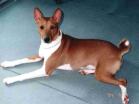 Basenji Basenji
The Basenji is one of the oldest pure bred dogs in existence today.
Basenjis were the much beloved pets of the Pharaohs of Ancient Egypt and
more recently are still used by African tribesmen for hunting small game.
Because of the Basenji's inability to bark wooden bells made from the
Borassus nut are tied around their necks to allow the hunter to keep track
of his dog. The natives hold their Basenjis in such high esteem that they
seem to have equal rights with their masters and they enjoy being carried
around their masters necks to the hunt. Basenjis are known to be barkless
but this does not mean that they are silent.
The Basenji - a gift from Afrika
The Basenjis are amongst the oldest dogs of the World. The name Basenji
means "small wild thing from the bush", which sounds in the language of
the Pygmies like "Basenji". This indicates already the origin in Central
Africa, that stretched from the heart of the Congo Basin to South Sudan.
The Basenjis lived there for thousands of years in a close relationship
with the natives e.g. the Pygmy tribes. Normally the dogs lived as an
independent pack near to the villages and supported themselves as a rule
(dependant on the tribe culture).Also reproduction took place for
thousands of years without any special control from humans.
The breed has therefore remained very original. Basenjis are regarded as
belonging to the group known as "Schensi-Dogs". This describes dogs that
have not been domesticated, that remain wild. Other well known members of
the Schensi family are the well known Australian dingo or the Canaan dog
from Israel. The origin of the Basenji becomes clear through one thing,
that it, like the wolf, comes on heat only once a year and then for a
period of 30 days. Also Basenjis cannot bark-caused by their flat larynx.
The bark is for humans an appropriate dog characteristic. Also the wolf,
as forerunner of the dogs, as well as the original dog breeds does not
have this ability. Although the Basenji lives completely independent from
the affiliated native tribe, it is inestimably useful.
In an area where animal egg white is in short supply, the Basenji is still
used as a hunting dog. In the course of this, it tracks down marsupials
and drives them into a net spread out by the hunters. During the hunt, so
that the hunters know at any time the whereabouts of the dogs, they wear a
kind of bell around the neck made from hollowed out shells with small
bones inside.
One could talk of an intervention in the breeding by humans in the nature
of this breed, that in the last five thousand years of its existence so
much importance has been attached to its optimal suitability as a hunt
driver. A good hunting dog was and is highly compensated, a bad one in
many tribes goes perfectly as a delicacy into the cooking pot!
As a result of this "breeding intervention", the Basenjis have a very
strong distinctive hunting urge, an excellent sense of smell and are
overall agile and suitable for cross country work. They can compete with
greyhounds in speed and direction changing
Another presumption is that the Basenjis reached Central Africa as war
trophies; Egypt had lost a war against the Sudan and the victors required
for their people the at-that-time most valuable things, namely, precious
metals, woman and dogs.
Once again around 1870, African explorers discovered a breed of dog that
was small, had long legs, a ringed tail and a short silky fur, in short
the Basenji. One of the first Africa explorers, who also described the
dwarf Pygmies with strange dogs, was Dr. Schweinfurth. Fascinated, he
decided at the end of one of his studies to take a bitch, that appeared to
him to be particularly intelligent, back to Europe. The Basenjis urge for
freedom came however on the return trip to Europe in Alexandria where she
jumped to her death from the second floor of a hotel.
In 1894 appeared finally the first report about Basenjis, still not
introduced as breed, in Europe. Since about 60 years the BASENJI is
recognised as a breed.
The first big breeder of Basenjis was Mrs Olivia Burn, who repeatedly
acquired dogs from the Pygmies in the Congo basin. After several failures
(the dogs died from distemper) she established the breed. In 1937 she
created a sensation at Crufts with the exhibition of her first puppies.
Judge and breeder were positively besieged by the crowd and bombarded with
questions. In the fifties, another famous breeder, Veronica
Tudor-Williams, successfully acquired further Basenjis from Africa to
freshen up the European stock. She discovered the dog "Fula of the Congo"
herself on an expedition in the South Sudan on the border with Zaire, and
later wrote a book about it.
Why has this ancient breed remained so
unknown to us?
A Basenji is not suitable for all dog lovers. It is indeed highly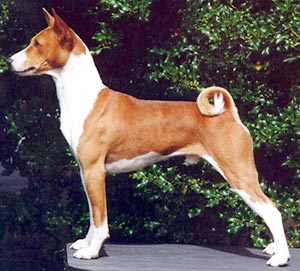 intelligent and social, very devoted and extremely clean. It does not bark
but this does not mean that it is dumb. They express their pleasure in
meeting again with a joyful howl that is similar to a jodel. They register
their displeasure with an impressive growl and possess a diverse form of
articulation in their dealings with the other pack members. The natives
describe it often as a "talking dog".
intelligent and social, very devoted and extremely clean. It does not bark
but this does not mean that it is dumb. They express their pleasure in
meeting again with a joyful howl that is similar to a jodel. They register
their displeasure with an impressive growl and possess a diverse form of
articulation in their dealings with the other pack members. The natives
describe it often as a "talking dog".
On the other hand, and this puts off many enthusiasts of dogs as
companions, the Basenji is very independent. When given an order, that it
properly understands, if it is really sensible, and at that moment
reasonable, to carry it out, and as a rule it is not. In addition, led by
its extremely strong urge to hunt, one cannot let it off the leash
everywhere. Basenjis that runaway are often a short while later run over
by a car. As the dog, although having an outward appearance of elegance,
is very strong and has the tendency on a walk to pull on the lead, it
cannot be led by small children.
When however the “bad” habits of the breed as described are not
disturbing, one can find with a Basenji a loving, devoted, intelligent
companion, prepared at any time for a joke.
Want great
medicine for your Basenji's arthritis?
Try Synflex. the arthritis medicine that they offer really does help
dogs of all types, sizes, breeds, and medical backgrounds.
Check out synflex
for your Basenji today!
Basenji, basenjis, dog breeders, puppies
Basenji classified ads for purebred puppies. Includes dogs from
professional to hobby Basenji dog breeders.
Basenji Rescue and Transport, Inc.
Basenji Rescue and Transport Adoption, Placement, Health & Foster Care, Education,
Support, and more.
The Basenji Magazine - Devoted to Basenjis Worldwide Since 1964
The Basenji Magazine Logo Merchandise July/August 2005
Dogs - Pictures, Breeders, Puppies, Rescue, Photos
Dogs pictures. Pictures of DOGS has great Dog pictures! New dog
pictures added periodically!
Basenji Companions, the club devoted to pet Basenjis
Basenji Companions: The Club Devoted to Pet Basenjis ... Basenji Traits. Tell us how many of these common Basenji traits your dog(s) have.
The Basenji Club Of Southeastern Wisconsin
The Basenji Club of Southeastern Wisconsin. Our mission is to
encourage, promote and preserve the natural quality in the breeding of pure-bred
Basenji.
Basenji Club of America, African Barkless Dogs
Basenji Club of America
Northwest Barkless Basenjis
The Basenji is a small hunting dog from Africa. Here you will find a
growing database of Basenji information for the world.
Basenji.com
Source for breed information and links, focusing on rescue and education.
Basenji Club of Canada - Portal Page
The official Basenji Club Of Canada website representing the barkless dog out of Africa.
|
|
 Your Dog Zone.com